study nursing in Georgia over the past few years, Georgia has become one of the most attractive destinations for international students who want to study healthcare-related programs, nursing in particular. Affordable tuition compared to Western Europe, English-taught programs, and a relatively simple admission process have made Tbilisi’s universities a regular feature in the study-abroad plans of thousands of students every year. Still, choosing the right university should never be a random decision — there are real differences between institutions in terms of type (public vs. private), tuition fees, and how well each specific nursing program is accredited.
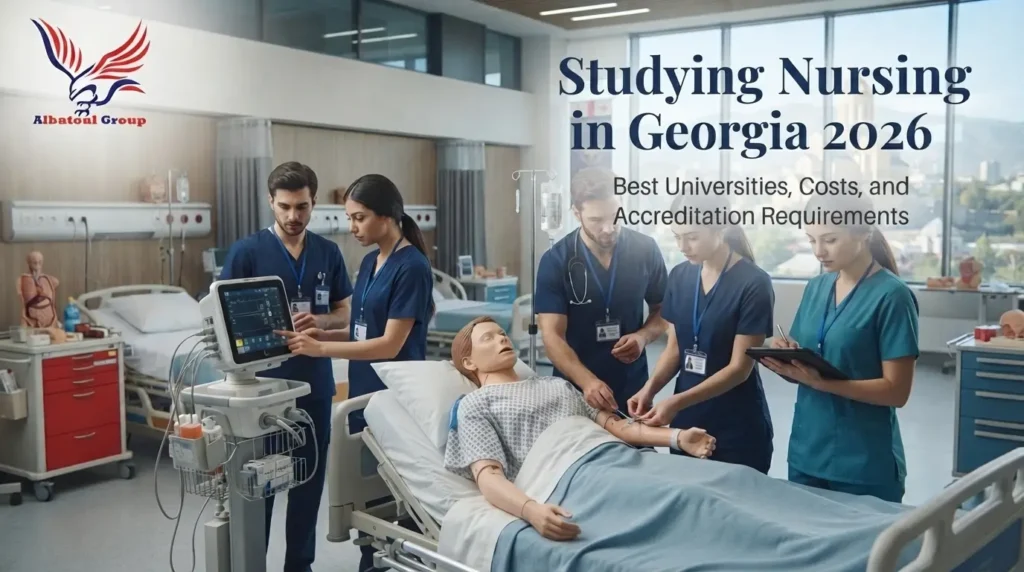
This guide walks through the leading Georgian universities offering a Bachelor’s degree in Nursing (BSc in Nursing), compares tuition costs side by side, and explains exactly how academic accreditation works in Georgia — so students and parents can make a decision based on verified information rather than agency marketing alone.
Why Students Choose Georgia for Nursing Studies
Several factors explain Georgia’s growing popularity as a nursing destination:
- Relatively low cost: Annual tuition for nursing programs typically ranges between $3,000 and $6,000 per year — considerably lower than equivalent programs in Western Europe or North America.
- English-medium instruction: Most major universities offer the nursing program entirely in English, removing the need to master Georgian before enrolling.
- Manageable travel distance: Compared to more distant destinations, Georgia is relatively close to the Gulf countries and Egypt, with direct or short connecting flights.
- Modern clinical infrastructure: Several universities operate their own teaching hospitals or maintain partnerships with major hospitals for clinical training.
- Clear postgraduate pathway: Nursing graduates can later pursue a Master’s degree in a nursing specialization or health management, and eventually a PhD for those interested in an academic or research track.
First, Understand How Accreditation Works in Georgia (a Point Most Guides Skip)
Before comparing universities, it’s essential to understand how Georgia’s higher-education quality-assurance system works, since this directly affects how strong a degree is when it comes to sitting professional licensing exams or getting the degree recognized abroad later.
The official body responsible for quality assurance in Georgian higher education is the National Center for Educational Quality Enhancement (NCEQE). It is internationally recognized as Georgia’s official ENIC/NARIC center, a full member of the European Association for Quality Assurance in Higher Education (ENQA), and is registered in the European Quality Assurance Register (EQAR).
NCEQE runs two separate mechanisms, and the distinction between them matters a great deal:
- Institutional Authorization: an evaluation of the university as a whole, determining whether it meets the baseline standards required to legally operate as a higher-education institution in Georgia.
- Programme Accreditation: a more granular evaluation of a specific academic program (for example, the Bachelor of Nursing program at a specific university), carried out through a self-evaluation report and an on-site visit by a panel of subject experts.
Here’s the crucial detail: programme accreditation in Georgia is legally mandatory only for regulated professions — Medicine, Law, Teacher Education, Maritime Education, Veterinary Medicine — plus all doctoral programs. Nursing is not automatically included in this mandatory list in every case, which means some nursing programs may operate under the university’s general institutional authorization without a separately renewed program-level accreditation.
Why does this matter to you as a student? Because program-level accreditation specifically is what reassures a student that the curriculum meets recognized standards, and it materially affects how smoothly the degree can later be recognized or used to register with nursing boards in certain countries. We strongly recommend that every prospective student personally verify the current accreditation status of the specific nursing program (not just the university’s general license) through NCEQE’s official portal, or by requesting the official accreditation certificate directly from the university’s international admissions office before enrolling or paying any fees.
It’s also worth checking whether the university or faculty is listed among the World Health Organization’s (WHO) recognized medical education institutions. This listing is primarily relevant to medicine graduates, but it is sometimes used informally as a general credibility indicator for the wider medical faculty a nursing program belongs to.
Top Universities Offering Nursing Programs in Georgia
1. University of Georgia (UG)
Founded in 2004 in Tbilisi, UG is one of the country’s leading private universities, offering a wide range of programs in medicine, law, business, and technology, including a Bachelor of Nursing.
- Type: Private.
- Program length: 4 years (240 total credits, including roughly 228 ECTS of core courses and 12 ECTS of electives).
- Language of instruction: English for international students (Georgian is a compulsory foreign-language course within the curriculum for international students).
- Approximate tuition: Around $4000 per year for international students.
- Teaching approach: UG uses Problem-Based Learning (PBL), an interactive method built around real-life case studies designed to build critical-thinking skills in nursing students.
- Clinical training: Practical and laboratory groups are capped at 15 students, with 90 ECTS credits dedicated entirely to clinical practice across various medical facilities.
- After graduation: Graduates can pursue a Master’s in a nursing specialization, and later a PhD.
2. Tbilisi State Medical University (TSMU)
TSMU is Georgia’s oldest and largest public medical university, founded in 1918, having trained more than 40,000 doctors over more than a century. The university established its first professional nursing program in 2007, making it one of the earliest institutions to formalize academic nursing education in Georgia.
- Type: Public (state).
- Relevant faculty: Faculty of Nursing and Midwifery, one of five core faculties alongside Medicine, Pharmacy, Public Health, and Physical Medicine & Rehabilitation.
- Language of instruction: Programs are available in Georgian, English, and in some cases German.
- Approximate tuition: Estimates vary noticeably between sources — from around $3,500 up to roughly $6,400 per year — so we strongly recommend confirming the exact figure directly with the international admissions office, since the gap is significant and depends on the language track and intake year.
- International recognition: TSMU is listed among WHO-recognized institutions, which lends it strong academic credibility, particularly for its medical programs.
- General admission requirements: Applicants are typically expected to be between 17 and 25 years old at the time of application, be high-school graduates (or equivalent) with a background in physics, chemistry, and biology, plus proficiency in English.
3. Caucasus International University (CIU)
Founded in 1995 as a medical institute under the name “Clinitsist,” CIU has since grown into a multi-profile private higher-education institution. It received its initial license from Georgia’s Ministry of Education the same year, followed by institutional accreditation in 2005.
- Type: Private.
- Nursing program length: 4 years (Bachelor of Nursing Care track).
- Language of instruction: Fully in English for international students.
- Approximate tuition: Among the more affordable options covered here, at roughly $3,300 per year.
- Hostel fees: Range from $1,000 to $3,000 per year depending on room type.
- Program structure: A mix of basic sciences, core nursing coursework, and advanced clinical training at partner hospitals and healthcare centers.
- Administrative note: CIU operates as a licensed limited liability company (LLC) and has been granted several rounds of program accreditation by NCEQE’s Authorization Council over the years.
4. Georgian National University (SEU)
Founded in 2001 in honor of the Georgian writer and thinker Ilia Chavchavadze, SEU is located in Tbilisi’s historic district and is one of the largest private universities in the country by international student enrollment, with over 4,000 foreign students and substantial investment in its medical infrastructure.
- Type: Private.
- International memberships: Member of the European University Association (EUA) and the Association of Universities in the Black Sea Region (AUBSR).
- Nursing-related program: A BSc in Nursing that combines foundational nursing science, clinical practice, healthcare management, and professional ethics.
- Language of instruction: English.
- Approximate tuition: $3,500 per year, depending on the source.
- Institutional accreditation: SEU received accreditation from Georgia’s National Accreditation Center in 2009, and was re-authorized under the newer standard in 2014.
- Note: SEU is more widely known for its MD (Medicine) program given the scale of investment in that faculty, so students specifically interested in nursing should request the nursing curriculum details separately and compare it against the other options here.
5. New Vision University
One of the newer private universities in Tbilisi, New Vision offers a “Bachelor’s Program in Nursing Care” within its School of Medicine, alongside its Medicine, Dentistry, and Pharmacy programs.
- Type: Private.
- Stated program goal: To train competent, responsible nursing professionals equipped to work in a multicultural healthcare environment, with strong competencies in nursing management and patient care.
- Clinical training advantage: The university operates its own teaching hospital (New Vision Hospital) used for hands-on student training, in addition to partnerships with other healthcare facilities in Tbilisi.
- Tuition: Varies by program — as with every university listed here, request an official fee quote directly, since pricing is updated annually.
Quick Comparison Table
| University | Type | Program Length | Approx. Annual Tuition |
|---|---|---|---|
| University of Georgia (UG) | Private | 4 years | ~$4000 |
| Tbilisi State Medical University (TSMU) | Public | 4 years | $3,500 – $6,400 (varies by source) |
| Caucasus International University (CIU) | Private | 4 years | ~$3,300 |
| Georgian National University (SEU) | Private | 4 years | $3,500 |
| New Vision University | Private | 4 years | 4500 $ |
Important note: The figures above are approximate, compiled from multiple education sources, and actual tuition can change year to year, vary by language track, or depend on nationality-specific agreements. The only 100% reliable step is requesting an official admission offer from the target university’s international admissions office, which will state the exact tuition tied to your name and application number.
study nursing in Georgia Additional Costs to Budget For (Beyond Tuition)
- Housing: Student housing or rented apartments in Tbilisi typically cost between $100 and $300 per month, depending on the neighborhood and accommodation type.
- Daily living expenses: (food, transport, utilities) generally require $200 to $350 per month for a single student living moderately.
- Mandatory student health insurance: Usually required, with an annual cost ranging from $100 to $350 depending on the provider.
- Application and registration fees: Vary by university and are usually paid once at the time of enrollment.
study nursing in Georgia General Admission Requirements for Nursing Programs in Georgia
While details differ slightly between universities, the following requirements are broadly common across the institutions covered above:
- A high-school diploma or equivalent, with an acceptable GPA (some universities require a minimum grade in physics, chemistry, and biology).
- Proof of English proficiency (usually B1 or B2 level), which may be waived for students whose entire secondary education was conducted in English.
- A valid passport with sufficient remaining validity (usually at least 18 months).
- Applying through Albatoul Group admissions office, receiving a conditional offer letter, then paying the first semester’s tuition to confirm enrollment and begin the D-type student visa process.
- Some universities require a short interview or a basic written assessment as part of the admission process, particularly for health-related programs.
After Graduation: Career Prospects and Degree Recognition
Graduates of a Bachelor of Nursing from a Georgian university can work in healthcare facilities and hospitals, either within Georgia or in their home countries after completing the degree-recognition process locally. The program also opens the door to a nursing specialization, a Master’s in Nursing or Healthcare Management, and eventually a PhD for those pursuing an academic or research path.
It’s important to note that degree recognition rules vary significantly from one country to another, and some countries require passing local professional licensing exams (such as nursing board exams in certain Gulf countries). We recommend contacting the relevant credential-recognition authority in your home country before enrolling, to confirm that the specific university’s degree is accepted on their recognized-institution list.
study nursing in Georgia
Georgia offers a genuinely practical, affordably priced path to studying nursing in English, with a real mix of public and private options. But as with any major academic decision, success on this path starts with choosing a university that holds a clear institutional authorization, personally verifying the accreditation status of the specific nursing program, and comparing actual tuition and services before committing to any payment.
If you’re looking for direct consultation and full support with your application to any of the Georgian universities listed above — from choosing the right university, all the way through your student visa and arrival in Tbilisi — the Albatoul Group team is ready to guide you through every step of the journey.
About Albatoul Group
Albatoul Group is a licensed university admissions office based in Georgia, operating since 2018. We’ve guided hundreds of Arab students through every step of their study-abroad journey — from choosing the right university and major, through the application and enrollment process, to securing a student visa and settling into life in Tbilisi. Beyond university admissions, Albatoul Group also offers tourism and real estate investment services across Georgia. To learn more or start your application, reach out via albatoulgroup.net or albatoulgroup.ge.