study in Azerbaijan FAQ Azerbaijan has quietly become one of the more interesting study destinations between Europe and Asia. Baku is a modern, walkable capital on the Caspian Sea. Several universities teach in English. Tuition at many institutions is far lower than in Western Europe. Yet because the country is newer to the international education market, prospective students often struggle to find clear, reliable answers.
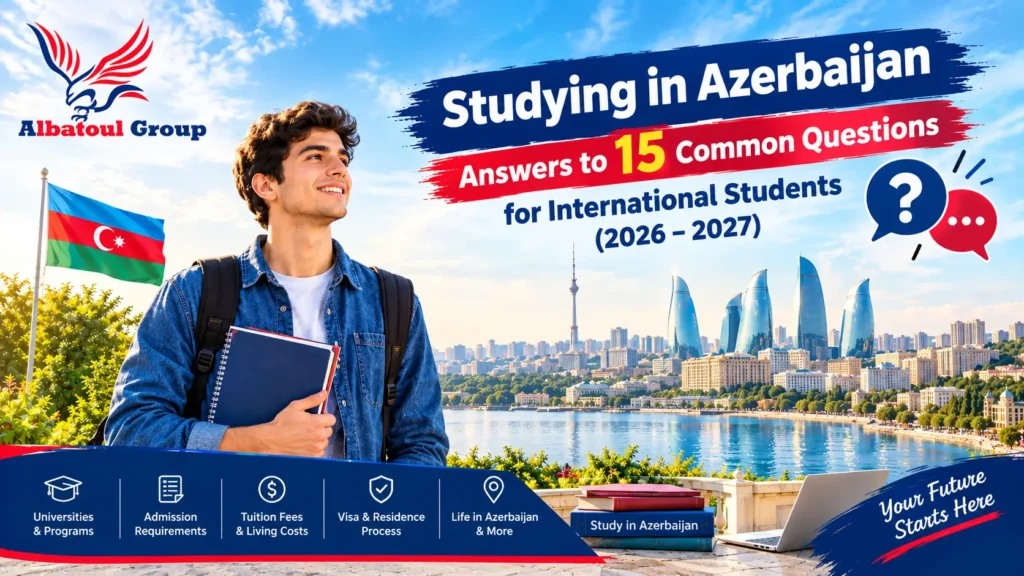
This guide collects the 15 questions we hear most often from international students and their families, and answers each one directly. Where an answer depends on a university’s own published rules, we say so and tell you where to confirm it. Where a figure comes from an official source, we name the source. Where something has no single official answer (degree recognition is the main example), we explain the real mechanism rather than giving a comforting but inaccurate yes.
Albatoul Group is an international student recruitment and enrollment consulting agency. We help students choose a suitable university, prepare their documents, and complete registration. The answers below reflect the official information we have verified; always confirm final fees and dates with the university before you pay.
1. Is Azerbaijan a good country to study in?
For many students, yes, provided you choose the university and the program carefully. The main advantages are:
- Affordable tuition. Official fee schedules at several state and private universities sit in the range of roughly USD 1,200 to USD 5,000 per year for many English-taught programs (details in Question 3).
- English-taught programs. Several universities offer full degrees in English, particularly in business, IT, engineering, and international relations.
- A growing international profile. Baku State University entered the QS World University Rankings 2027 at position #565, and Azerbaijan State Oil and Industry University (ASOIU) ranked 711–720, the first time three Azerbaijani universities appeared in QS’s top 800.
- Location. Baku sits between Europe, Turkey, Central Asia, and the Gulf, with direct flights to many regional hubs.
The main things to plan for are that some programs (especially medicine and law) are taught partly or fully in Azerbaijani or Russian, that degree recognition at home must be checked individually, and that the visa and residence process has strict deadlines. The rest of this guide covers each of these.
2. Which universities are best for international students?
There is no single “best”; it depends on your field, budget, and language. These are the institutions we most often discuss with students:
| University | Type | Why students consider it |
|---|---|---|
| Azerbaijan Medical University (AMU) | State | The country’s main medical university; six faculties; IAAR/WFME accreditation |
| Baku State University (BSU) | State | Founded 1919; 16 faculties; highest QS 2027 position among Azerbaijani universities (#565) |
| Azerbaijan State Oil and Industry University (ASOIU) | State | Founded 1920; engineering and energy focus; UFAZ dual-degree partnership with the University of Strasbourg |
| Khazar University | Private | 81 English-taught programs (25 bachelor’s, 40 master’s, 16 doctoral) at a flat USD 5,000 per year |
| ADA University | State-affiliated (under the Ministry of Foreign Affairs) | Founded 2006; English-medium; strong in diplomacy, IT, and business; SAT and IELTS-based admission |
| Nakhchivan State University (NSU) | State | Founded 1967; Medicine available in Azerbaijani and English; among the lowest tuition levels |
Note that Nakhchivan State University (a state university, founded 1967) is a different institution from the private Nakhchivan University. Check the exact name on any offer letter.
3. How much does tuition cost?
Fees vary widely by university and program. Based on the official fee schedules we have reviewed:
- Khazar University: USD 5,000 per year for all 81 English-taught programs listed for international students.
- ADA University: roughly AZN 8,500 (about USD 5,000) per year for undergraduate programs, and roughly AZN 10,500 (about USD 6,175) for most master’s programs. Some joint IT and engineering master’s programs are a flat USD 36,200.
- Nakhchivan State University: Medicine at USD 2,941.18 per year (Azerbaijani and English tracks); International Relations, Economics, and Computer Engineering at USD 1,176.47 per year; two master’s programs at USD 1,470.59.
- Baku State University and ASOIU: per-specialty tables are published by each university; they differ by program and level.
Two cautions. First, these are tuition figures only; accommodation, food, health insurance, and residence-permit fees are separate. Second, fees change between academic years, so confirm the current schedule with the university or with us before paying any deposit. Our separate guide Cost of Studying and Living in Azerbaijan 2026 breaks down a realistic monthly budget.
4. What language are the programs taught in?
It depends on the university and the program:
- English: widely available at Khazar, ADA, and in selected programs at BSU, ASOIU, and NSU.
- Azerbaijani and Russian: common at state universities, especially in older, established faculties.
- Medicine: AMU and NSU both offer medical education; always confirm whether the specific track you are applying to is taught in English, as some programs at NSU (Dentistry, Pharmacy, Public Health) are listed as Azerbaijani-only.
Azerbaijani law allows universities to assess a foreign applicant’s language proficiency and academic readiness themselves (Cabinet of Ministers Resolution No. 125 of 1 May 2015, as cited in BSU’s own admissions FAQ). In practice that means an English certificate (such as IELTS or an internal test) or an interview for English-taught programs, and a preparatory language year for programs taught in Azerbaijani.
5. Can I study medicine in Azerbaijan?
Yes, but the list is short and the details matter. Azerbaijan Medical University (AMU) is the country’s principal medical university, and Nakhchivan State University also offers Medicine, at USD 2,941.18 per year in the Azerbaijani and English tracks according to its official fee schedule.
Important points:
- Khazar University does not currently list Medicine among its programs for international students in the official schedule we reviewed.
- Medical graduates who plan to practice at home face additional professional requirements (see Question 12).
- Always request written confirmation of the language of instruction, the program length, and the clinical training arrangements before you apply.
6. What are the admission requirements?
Requirements vary, but the common core for a bachelor’s program is:
- A completed secondary school certificate with transcript
- A valid passport
- Passport-style photographs
- A medical certificate (and often an HIV test result) as required by the university
- Proof of English proficiency for English-taught programs
- Completed application form and application fee, where applicable
For master’s programs, a recognized bachelor’s degree and transcript are added. Some universities add specific tests: ADA, for example, asks for an SAT score (1200) and IELTS (6.0) for its undergraduate programs.
Your academic documents usually must be authenticated: either with an apostille (if your country is part of the Hague Convention) or through consular legalization by the Azerbaijani embassy. Our guide Admission Requirements and Required Documents to Study in Azerbaijan 2026 explains the difference and the sequence step by step.
7. Do I need to sit an entrance exam?
For most international applicants applying from abroad, the process is document-based plus a language or readiness assessment set by the university, rather than the national State Examination Centre (SEC) exams that Azerbaijani citizens take. Certain categories, such as foreigners holding a permanent residence permit, may follow different rules. Because each university sets its own assessment, ask the admissions office for its current international-applicant procedure.
8. How do I get a student visa?
The usual sequence is: apply to the university, receive the admission or invitation letter, then obtain an education-type visa. Two practical points:
- Students typically enter on a student visa valid for about three months, then convert to a temporary residence permit once in the country.
- The ASAN e-visa (evisa.gov.az) is a short-stay visit visa: USD 20 standard (3 working days) or USD 50 urgent (3 hours), valid for 90 days with up to 30 days’ stay, single entry. It is intended for visits, not for a full course of study, and eligibility depends on your nationality.
Because visa rules and fees are updated from time to time, check evisa.gov.az and the Azerbaijani embassy for your country, and read our dedicated guide Azerbaijan Student Visa 2026: Step-by-Step Guide for the full procedure.
9. What is the student residence permit and who applies for it?
International students on full-time study programs obtain a temporary residence permit (TRP) based on their enrollment. The universities handle much of this: according to the State Migration Service, applications for temporary residence should be submitted by the university at least 30 days before the student’s permitted stay expires. Students are also expected to register at their place of stay with the State Migration Service shortly after arrival (embassy guidance cites 15 days), and failure to register can bring fines.
The practical takeaway: do not let any deadline slip. Keep your passport, visa, and registration documents organized, and keep in contact with your university’s international office.
10. Is university housing available?
It varies, and it is worth asking before you accept an offer.
- Dormitories exist at several state universities (for example BSU and NSU, and Khazar at its Dunya Campus), though capacity and conditions differ.
- ADA University does not run a traditional dormitory; it offers an off-campus furnished-apartment arrangement through “Univerium”.
- Private rental in Baku is common for international students, with prices depending on district and whether you share.
Our university profile articles include a dedicated housing section for each institution, sourced from its official website. Ask for the current dormitory fee in writing.
11. Can I work while studying?
Do not assume you can. Under Azerbaijani migration rules, a foreigner who wants to work needs a work permit, which is generally applied for by the employer through the State Migration Service. Student status on its own does not grant a right to work, and the embassy guidance we reviewed notes that the student visa requires full-time study. If a part-time job or internship matters to your plans, ask your university and the State Migration Service for the current position in writing before you rely on it, and budget on the assumption that you will not have employment income.
12. Will my degree be recognized in my home country?
This is the most important question to research, and the honest answer is: it depends on your home country and your field.
For Egyptian students, there is no pre-published official list of “recognized Azerbaijani universities”. Instead, Egypt’s Supreme Council of Universities evaluates degree equivalency case by case after graduation. For medical degrees, the Egyptian Medical Syndicate applies additional requirements, including aspects such as the teaching hospital, practice recognition in the country of study, and the student’s high school track.
Practical steps:
- Choose a university that is accredited and internationally listed (the universities profiled in this series meet the objective criteria we apply).
- Contact your home country’s ministry or higher-education council before enrolling and ask for their current requirements in writing.
- Keep every transcript, syllabus, and attendance record from your studies.
Our full article Recognition of Azerbaijani University Degrees in Egypt explains this process in detail.
13. Are scholarships available?
Some Azerbaijani scholarship programs exist, but they are generally channeled through intergovernmental arrangements: candidates are shortlisted by authorities in their home country and forwarded through diplomatic channels. They are competitive and are not allocated by private agencies. If you are planning a self-funded study path, budget for the full tuition and living costs, and treat any scholarship as a possible bonus rather than part of your plan. Be cautious of anyone who guarantees you a scholarship for a fee.
14. Is Azerbaijan safe and comfortable for international students?
Azerbaijan is widely regarded as one of the safer destinations in its region, and Baku is a modern, well-lit city with a metro, buses, and taxis. It is a secular country with a Muslim-majority population, and many international students from Muslim-majority countries find halal food and prayer facilities easy to access. As in any country, take normal precautions, learn basic local rules, and check your own government’s current travel advisory before you travel.
15. When should I apply, and how can Albatoul Group help?
Most universities begin their main academic year in September, and the admissions, document authentication, and visa steps together take weeks, sometimes months. Applying early gives you time to fix any document problem. Intake dates and deadlines differ by university, so confirm them directly.
Albatoul Group assists international students with:
- Choosing a university and program that fits your goals and budget
- Preparing and checking your application documents
- Submitting your registration to the university
- Following up on your admission letter and next steps
Quick Summary
| Question | Short answer |
|---|---|
| Typical tuition | From about USD 1,200 to USD 5,000+ per year, depending on program |
| English programs | Yes, mainly at Khazar, ADA, and selected programs elsewhere |
| Medicine | AMU and NSU; confirm language of instruction |
| Student visa | Education visa, then temporary residence permit via the university |
| Work while studying | Requires a work permit; do not assume it is allowed |
| Degree recognition | Case by case; check your home country’s rules first |
study in Azerbaijan FAQ
Ready to start your application? Talk to an Albatoul Group advisor on WhatsApp and get a personalized recommendation for your program, budget, and documents.
👉 WhatsApp: https://wa.me/995597713045
Website: albatoulgroup.net · Instagram and YouTube: @albatoulgroup