One of the most important questions any international student asks before making a final decision: “How much will studying and living in Azerbaijan actually cost me per year?” The precise answer depends on three core factors: tuition fees (which vary by university, field, and degree level), monthly living expenses (which depend on your housing choice and lifestyle), and one-time arrival costs (like visa fees, registration, and initial settling-in expenses). In this guide, Albatoul Group breaks down every line item precisely, so you can plan your budget with confidence before you travel.
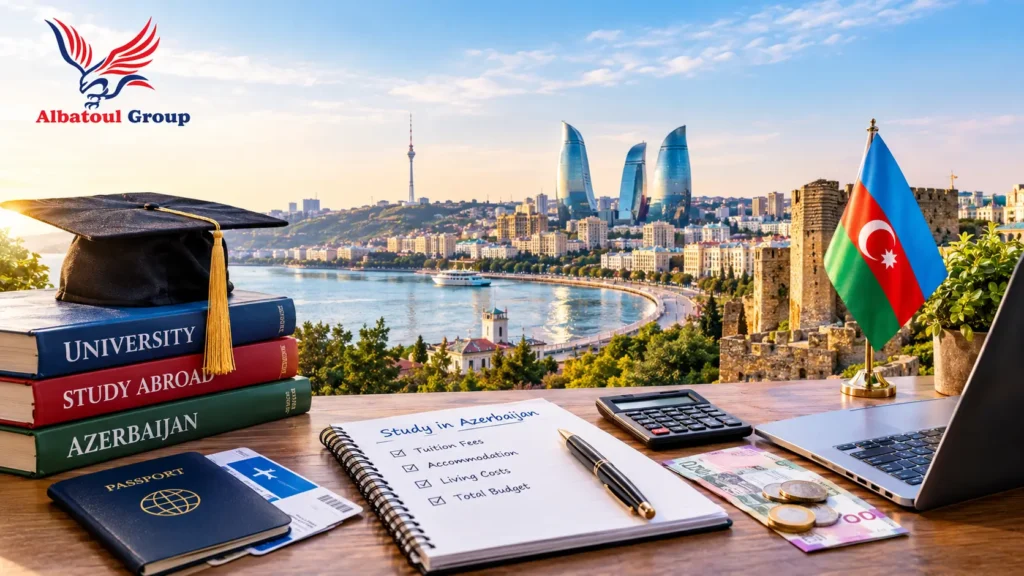
Quick Overview: Annual Budget Summary
Broadly speaking, a realistic annual budget for an international student in Azerbaijan (outside medical fields) ranges roughly between $5,000 and $11,000 USD per year, depending on the university, housing, and lifestyle. (If your field is Medicine, the numbers are somewhat different and higher — see our guide “Study in Azerbaijan 2026: The Complete Guide” for full details on medical tuition at each university.)
Approximate exchange rate (June 2026): 1 USD ≈ 1.70 Azerbaijani Manat (AZN). The figures in this guide are approximate and can change based on exchange rates and each university’s own policy, so we always recommend confirming current figures directly with us.
Tuition Fees by Degree Level
Preparatory Language Courses
If you need a preparatory year for language or academic level before starting your main program, costs range between $600 and $2,000 per year.
Bachelor’s Degree
Most bachelor’s programs (outside Medicine) cost between $1,000 and $2,500 per year. Humanities, education, and economics fields are generally at the lower end, while high-demand fields like computer science, software engineering, and business administration can be at the higher end.
Master’s Degree
Master’s programs range between $1,000 and $4,000 per year, with business administration, IT, engineering, energy, and international relations programs typically priced differently depending on the university.
Doctoral Programs
PhD programs range between $1,500 and $4,000 per year, and it’s important to also budget for research-related costs (document translation, thesis procedures, conference participation, and sometimes lab or fieldwork expenses).
Housing Options and Costs
Housing is usually the largest single item in your budget, and Baku specifically is more expensive than Azerbaijan’s smaller university cities — but choosing the right housing type can significantly reduce your expenses:
| Housing Type | Approximate Monthly Cost | Best For |
|---|---|---|
| University Dormitory | $100-$250 | Budget-conscious students |
| Shared Apartment | $200-$400 | Students wanting independence at a reasonable price |
| Private Apartment | $400+ | Students wanting more privacy and comfort |
| Temporary Stay on Arrival | $10-$40/night | The first days after arrival before securing permanent housing |
⚠️ Important tip: Don’t pay a large deposit before actually verifying the property. It’s best to choose university-recommended dormitories, a verified private residence, or an apartment close to a metro station and public transport. Before signing a contract, check the heating system, internet, location, building security, contract terms, and who’s responsible for monthly utility bills.
Core Monthly Living Expenses
| Item | Approximate Monthly Range | Notes |
|---|---|---|
| Food and groceries | $120-$250 | Cooking at home is cheaper than eating out constantly |
| Utilities (electricity, water, heating) | $40-$100 | Varies by season |
| Mobile internet | $10-$25 | Depends on the data package |
| Public transport | $15-$40 | Metro and buses in Baku are relatively cheap |
| Personal expenses | $50-$150 | Clothes, personal care, entertainment, small shopping |
| Study materials | $10-$50 | Books, printing, stationery, software |
In practice, a realistic monthly budget for a student in Baku (excluding tuition) usually falls between $300 and $600 per month. Students in shared housing tend to fall closer to the lower end, while those choosing a private apartment and a more comfortable lifestyle should plan for the higher end.
Getting Around Baku
Baku’s public transport system is quite reasonably priced. The BakıKart (the unified transport payment card) costs around 2 AZN, and a single metro fare costs roughly 0.60 AZN. For private trips, apps like Bolt and Yango tend to be more transparent than regular taxis in terms of route and estimated fare before the ride.
Health Insurance
Health insurance is strongly recommended for every international student in Azerbaijan, and some universities or scholarship programs require it as mandatory. Without insurance, private healthcare in Baku can become expensive, especially for specialist visits or emergencies. Budget roughly $100 to $300 per year for insurance, depending on coverage level.
Visa and Legal Registration Costs
After arriving on an education visa, you’ll need to complete migration and residence procedures. Any foreign national residing in Azerbaijan for more than 15 days must register their place of residence, through the State Migration Service or an ASAN service center.
The temporary residence permit fee for full-time students (valid up to one year) is approximately 40 to 60 AZN (roughly $24-$35), and can vary depending on processing time. Budget additionally for translation, notarization, medical checks, and other possible administrative costs.
One-Time Arrival Costs
Your first month in Azerbaijan will generally be more expensive than the following months, since you’ll need to set yourself up from scratch:
| Item | Approximate Cost |
|---|---|
| Airport transfer | $10-$40 |
| SIM card and first mobile package | $10-$25 |
| Basic essentials (bedding, kitchen items) | $50-$150 |
| Rental deposit | Usually one month’s rent |
| Document translation/notarization | $20-$100+ |
| Emergency reserve | $200-$500 |
⚠️ Don’t travel with exactly the amount needed for tuition and nothing else. Always keep a small emergency reserve to ensure a smooth transition during your first weeks.
Sample Annual Budgets
1. Budget-Conscious Plan
- Tuition: $1,000-$1,800 per year
- Housing: Dormitory or shared room
- Monthly expenses: $300-$400
- Estimated total annual budget: $5,000-$7,000
Suitable for students who choose an affordable public university, dormitory or shared housing, cook at home, and use public transport.
2. Standard Budget (Most Common)
- Tuition: $1,800-$3,500 per year
- Housing: Shared apartment or a verified private residence
- Monthly expenses: $400-$600
- Estimated total annual budget: $7,000-$10,000
A realistic budget for most international students in Baku who want a reasonable comfort level while still controlling their spending.
3. Comfortable Budget
- Tuition: $3,000-$5,000+ per year
- Housing: Private apartment
- Monthly expenses: $600+
- Estimated total annual budget: $10,000-$14,000+
Suitable for students who’ve chosen higher-cost programs (such as some Medicine tracks or private universities), with a preference for private apartments and frequently eating out.
Practical Tips to Reduce Your Expenses
- Choose a university and program with clear, transparent tuition fees from the start.
- Prefer dormitory or shared housing over a solo private apartment.
- Use the metro and buses instead of taxis for daily commuting.
- Cook at home and shop at local markets instead of eating out constantly.
- Confirm every payment strictly through official university channels.
- Keep an emergency budget for your first month.
- Apply early for any available scholarship or financial aid.
- Be wary of unofficial agents or unauthorized “admission discount” offers — always work with a formally authorized enrollment office like Albatoul Group.
Frequently Asked Questions About the Cost of Studying and Living in Azerbaijan
How much monthly budget does a student need in Baku? International students generally plan for around $300-$600 per month in living expenses, excluding tuition, depending on housing type and lifestyle.
Is housing expensive in Baku? It varies significantly. University dormitories and shared apartments are usually much cheaper, while private apartments in central areas can be noticeably more expensive.
Can international students work part-time in Baku? It’s not advisable to rely on part-time work as a core budget plan unless you clearly understand the legal work rules and permit requirements. It’s always better to secure sufficient funding before traveling and confirm all work-related rules with your university and the relevant authorities.
Are there residence fees beyond tuition? Yes, the temporary residence permit fee for full-time students (valid up to one year) ranges between 40 and 60 AZN (roughly $24-$35), plus potential additional registration and translation costs.
What’s the cheapest way to study in Azerbaijan? The cheapest approach is generally choosing an affordable public university, living in a dormitory or shared apartment, using public transport, and applying early for any available scholarship or financial aid.
Planning your budget precisely before traveling is the single most important step toward a stable study experience. The Albatoul Group team, as an authorized enrollment office, is ready to help you determine the right university, program, and budget for your situation before you decide.