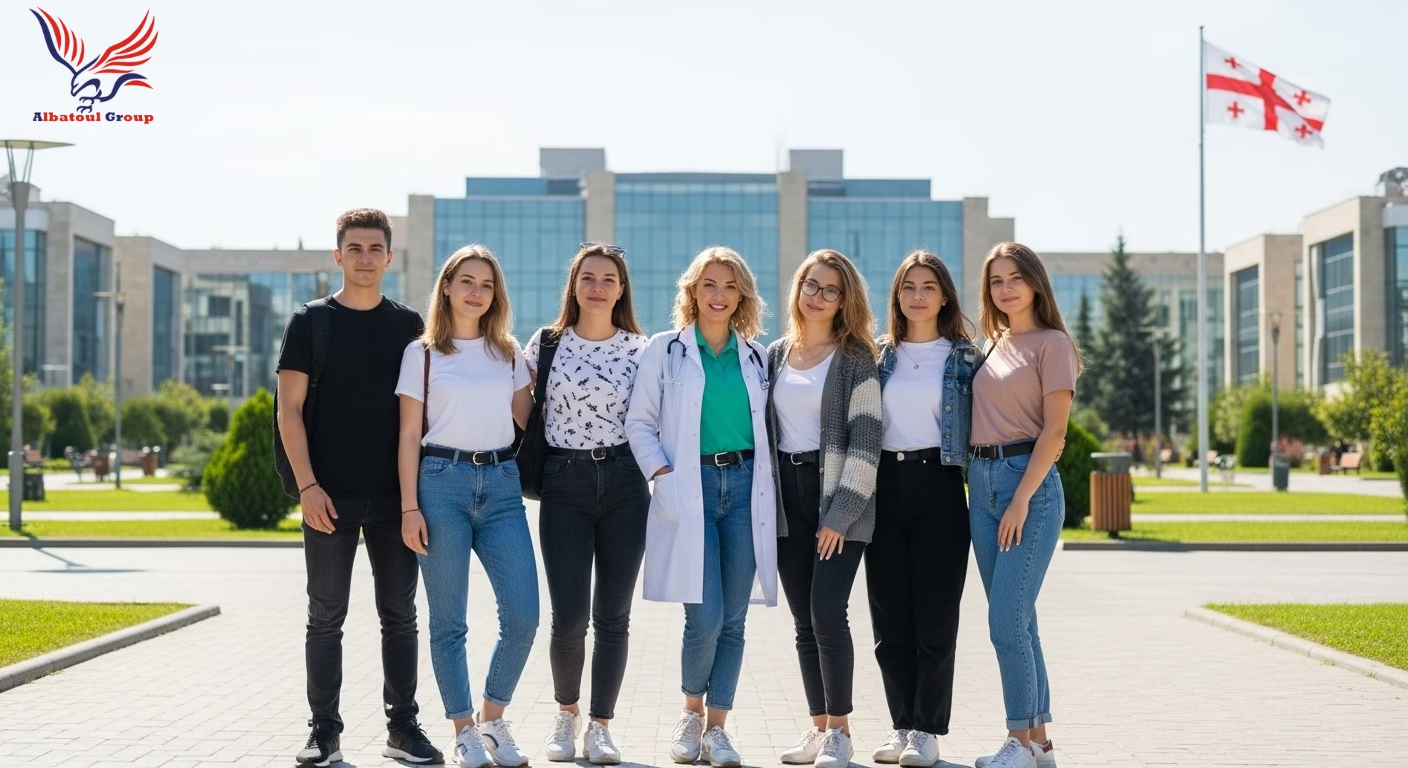
studying in Georgia for Lebanese students since Lebanon’s economic crisis deepened and the lira lost most of its value, thousands of Lebanese students, and their families right alongside them, have been searching seriously for study-abroad options that don’t crush the family budget while still delivering a degree worth holding. In the middle of that search, Georgia, the small country sitting at the crossroads of Europe and Asia, has emerged as a destination worth pausing on carefully, not just because it’s cheap, but because it combines English-taught programs, a European-aligned education system, and a cost of living that actually fits where many Lebanese families stand today.

But any Lebanese student who takes this option seriously will eventually run into a harder question than “how much does it cost?” — namely, will my degree even be recognized back home in Lebanon? That’s the exact question this guide sets out to answer clearly, alongside a look at the leading universities, the majors available, and the real costs involved, drawing as much as possible on official and verifiable sources.
studying in Georgia for Lebanese students How Are Georgian Degrees Actually Treated in Lebanon?
This is precisely where most of the confusion lives. Many students and parents assume Lebanon works the same way as Egypt or Saudi Arabia, where the relevant ministries publish official lists of “recognized” universities by country. Lebanon’s system is fundamentally different. The Lebanese Ministry of Education and Higher Education, through its Directorate General of Higher Education, does not operate a ready-made list by country. Instead, every degree is evaluated individually, through a specialized body known as the Equivalence Committee (لجنة المعادلات), established by ministerial decision under Decree No. 8869 dated July 26, 1996.
What does that mean in practice? It means a Lebanese student who, say, studies Business Administration, Engineering, or Information Technology at a Georgian university will, after graduating, submit an equivalence request to the Equivalence Committee’s secretariat at the UNESCO building in central Beirut, along with the required documents: the original degree, a transcript for every academic year, the high-school diploma or its equivalent, and proof of residence in Georgia throughout the study period. The committee then reviews the file against several criteria, chief among them: whether Georgian authorities themselves recognize the university as a whole (i.e., whether it holds official authorization from the National Center for Educational Quality Enhancement, NCEQE), the number of years studied and credit hours completed, and how closely the curriculum matches internationally recognized standards for that specific major.
In other words, there is no published “whitelist” or “blacklist” of Georgian universities specifically in Lebanon — but that doesn’t mean the process is arbitrary. A university that holds a clear institutional authorization from the relevant Georgian authorities, and offers a program with a reasonable, ECTS-aligned credit load, generally moves through equivalence far more smoothly than an obscure institution or a shortened program that doesn’t meet the requirements. Our standing recommendation to any Lebanese student, before enrolling anywhere in Georgia, is to request an official copy of the university’s NCEQE accreditation certificate directly and keep it on hand — it will be the single most important document when the equivalence file opens later.
A Special Case: Medicine, Dentistry, Pharmacy, and Nursing
If the major you’re considering falls under a regulated profession, namely Medicine, Dentistry, Pharmacy, or Nursing and Nutrition, the story doesn’t end at degree equivalence. A whole new chapter opens from there, known in Lebanon as the “Colloquium” exams.
Under the regulations in place, graduates of higher-education institutions located outside Lebanon, specifically in these fields, are required to sit a series of exams supervised by the Directorate General of Higher Education, in coordination with the relevant professional syndicates (the Order of Physicians, the Order of Pharmacists, the Order of Nutrition Specialists, and so on). These exams typically consist of three components: a written exam on a topic chosen by the examining committee, a general oral exam, and a practical or applied exam in the specific field, with the candidate required to pass each component separately, not just the overall average. The exams are conducted in either French or English, depending on the language of instruction, and candidates must first submit proof of a supervised training period of at least one month for General Medicine and Pharmacy graduates, or at least six months for Nutrition graduates.
We want to flag something particularly sensitive and current here: in the latter part of 2026, Lebanon saw widespread controversy and repeated sit-ins by foreign-university graduates in General Medicine, protesting the Ministry of Education’s decision to introduce an additional clinical exam known internationally as the OSCE, layered on top of the existing Colloquium exams, on the grounds of raising the required clinical competency bar for practicing the profession. Graduates argued the decision came late, without adequate notice to prepare, while the Ministry defended it as a necessary step to align Lebanese standards with international medical education norms.
What matters to you, as a student or a parent planning ahead, isn’t the details of that specific dispute, but the lesson it carries: Lebanon’s medical degree-equivalence system is not static — it is actively evolving, and what was true a year ago may not hold true today. Any information you receive about “requirements to practice after graduation” should be verified directly, and periodically, through the official website of the Ministry of Education and Higher Education and the relevant professional syndicate — not solely through a registration office or an education agency’s website, however credible it may seem.
studying in Georgia for Lebanese students Leading Georgian Universities and Their Available Majors
Georgia is home to dozens of licensed universities, but only a limited number actually attract international students, Lebanese included, thanks to their English-taught programs and infrastructure better suited to non-Georgian speakers. Here are the most prominent:
Tbilisi State Medical University (TSMU) is the country’s oldest and most established public medical institution, founded in 1918, and has been training doctors for more than a century. It is listed among WHO-recognized medical institutions. TSMU offers Medicine, Dentistry, Pharmacy, Nursing, and Public Health, with tuition starting around $3,500 per year for Nursing and Pharmacy, rising to roughly $7,000–$8,000 per year for Medicine.
Ivane Javakhishvili Tbilisi State University, Georgia’s founding and oldest university (also established in 1918), carries strong regional academic standing, particularly in the sciences and humanities, though its English-taught tracks for international students are less extensive compared to private universities that specialize in attracting foreign students.
University of Georgia (UG), one of Tbilisi’s leading private universities, offers a wide range of majors: Medicine, Dentistry, Pharmacy, Nursing, Law, Business Administration, and Information Technology, using an interactive Problem-Based Learning teaching approach, with competitive tuition starting around $3,500 per year for most programs.
New Vision University, a relatively newer private institution, operates its own teaching hospital used to train students in Medicine, Nursing, and Pharmacy, alongside Law and Business programs, with tuition ranging between $3,500 and $7,000 per year depending on the major.
Georgian National University (SEU), founded in 2001, is one of the largest universities by international enrollment (over 4,000 foreign students), with a full Faculty of Medicine covering Medicine, Dentistry, and Pharmacy, and academic partnerships with prestigious institutions like MIT and Berkeley.
Caucasus International University (CIU), Ilia State University, and the European University Georgia are also respectable options, each with strengths that vary by major, with tuition for non-medical programs generally ranging between $2,500 and $6,000 per year.
Which Majors Are Easiest for a Lebanese Student to Get Recognized?
Based on practical experience following past students’ files, one observation is worth stating plainly: unregulated majors — Business Administration, Information Technology, Engineering in its various branches, and International Relations — generally move through a simpler, faster equivalence path than medical fields, because they don’t require Colloquium exams or professional-syndicate approval. Academic equivalence from the Equivalence Committee is usually all that’s needed.
For anyone specifically set on Medicine, Dentistry, Pharmacy, or Nursing, it’s important to go into the decision fully aware that the road is longer: four to six years of study in Georgia, followed by degree-equivalence procedures, then a mandatory training period, then the three-part Colloquium exams, and possibly an additional clinical exam depending on the latest regulatory developments. This doesn’t necessarily mean the path isn’t worthwhile — thousands of doctors currently practicing in Lebanon originally graduated from foreign universities and completed this exact path successfully — but it does call for realistic financial and time planning from day one, not surprises down the line.
Why Georgia Specifically, Not Cyprus, Armenia, or Turkey?
This is a question almost every family asks before making a final decision, because these four destinations genuinely compete for the same Lebanese student. Honestly, there’s no single right answer that fits everyone — it comes down to each family’s priorities.
Cyprus, on both its Greek and Turkish sides, offers greater geographic proximity to Lebanon and notably easier travel, but its overall cost, especially on the Greek side, is clearly higher than Georgia’s; Medicine tuition there can run more than double what’s required in Tbilisi. Armenia is the closest match to Georgia in both model and cost, and is a genuinely comparable alternative, but the number of accredited universities there specializing in international students is less diverse. Turkey, despite its cultural and geographic closeness to Lebanon, has seen a noticeable rise in living costs in recent years, especially following the Turkish lira’s inflation, which has pushed the final cost at some universities there closer to Eastern European territory than to what one would call an economical option.
By comparison, Georgia has so far maintained relative stability in pricing tuition in US dollars, which gives a Lebanese family, already conducting most of its day-to-day transactions in dollars since the crisis, a clearer and more predictable financial planning horizon across the full duration of the degree — a factor that shouldn’t be underestimated for anyone who has lived through the volatility of the past few years.
Additional Costs: Housing, Living Expenses, and Insurance
Beyond tuition, there are line items that shouldn’t be overlooked when building an annual budget for studying in Georgia. Housing in Tbilisi, whether in university dormitories or a rented apartment, typically runs between $100 and $300 per month depending on the neighborhood and finish quality. Day-to-day living costs — food, transport, utilities — usually require between $200 and $350 per month for a single student living moderately. On top of that comes mandatory health insurance for international students, costing between $100 and $350 annually, plus application and registration fees paid once at admission, which vary by university.
Put differently, and setting aside promotional figures a student might hear from this or that agency, the realistic annual budget for study and living in Georgia, for a student in a non-medical field, generally falls somewhere between $6,000 and $9,000 per year, all-inclusive, while this budget rises noticeably for Medicine and Dentistry students given the higher tuition itself.
Practical Steps for a Lebanese Student Planning to Enroll
The first step, before any financial commitment, is confirming the target university’s authorization with Georgia’s National Center for Educational Quality Enhancement, and requesting an official copy of that authorization. Next comes choosing a major realistically, with full awareness of the equivalence path that follows if it’s a regulated profession. Then comes actually applying through the university’s international admissions office, which typically requires the Lebanese Baccalaureate or its equivalent, proof of English proficiency, and a valid passport with at least eighteen months remaining. Once the offer letter arrives, the D-type student visa process begins through the Georgian embassy or its representative offices. Finally — and this step is often skipped — it’s worth reaching out early, even just with a preliminary inquiry, to Lebanon’s Directorate General of Higher Education, to understand the current equivalence requirements before traveling, not after, saving considerable time and effort down the line.
studying in Georgia for Lebanese students Frequently Asked Questions from Lebanese Families
Is a Georgian degree “automatically” recognized in Lebanon upon graduation? No. As explained above, there is no automatic equivalence based on the issuing country. Every case is reviewed individually by the Equivalence Committee, and processing can take weeks or months depending on how complete the file is and the volume of applications at that time.
Can a Lebanese student work while studying in Georgia? Some student residence permits allow limited part-time work, but this varies by the type of residence permit granted and each university’s policy. It’s best to clarify this specific point with the admissions office before traveling, rather than relying on generally circulated information.
What if Lebanon’s Ministry of Education changes the equivalence requirements after I’ve already started studying? This is a genuinely real possibility, as we saw with the recently introduced OSCE exam example. The only practical way to manage this risk is ongoing monitoring — not just once at enrollment, but every year or two throughout the study period — so the student isn’t blindsided by new requirements they weren’t prepared for at graduation.
Do all majors require the Colloquium exam? No. Colloquium exams are exclusive to regulated health professions (Medicine, Dentistry, Pharmacy, Nursing, Nutrition, and similar fields). Graduates in Engineering, Business Administration, Information Technology, or Law typically only go through academic degree equivalence, without any additional professional exams.
studying in Georgia for Lebanese students
Studying in Georgia remains a realistic, sensible option for a large number of Lebanese students, especially under current economic conditions, but it’s not a decision that should be made on marketing promises alone. Success on this path starts with genuinely understanding how degree equivalence works in Lebanon — a system built on case-by-case evaluation, not ready-made lists — continues through personally verifying the target university’s authorization and program accreditation, and ends with a realistic financial budget that accounts for every cost, not tuition alone.
studying in Georgia for Lebanese students if you’re seriously planning to study in Georgia and want a trustworthy partner who knows every detail of this path from start to finish — from choosing the right university and major, through registration and visa procedures, to settling into life in Tbilisi — the Albatoul Group team is ready to walk with you through every step of the journey, backed by direct, on-the-ground experience in Georgia since 2018.
Disclaimer: The information in this article, particularly regarding Colloquium exams and requirements for regulated professions, is subject to ongoing change by Lebanese official authorities. Always check the official website of Lebanon’s Ministry of Education and Higher Education, or the relevant professional syndicate, for the latest updates before making any final decision.