English language requirements to study in Georgia One of the most common questions we get on WhatsApp before a student even applies: “I don’t have IELTS or TOEFL — does that mean I can’t enroll at a Georgian university?” The short answer: there’s no unified rule across all of Georgia requiring one specific international certificate. Each university sets its own policy for proving English proficiency. This guide gives you the real picture, with actual examples from different universities, so you’re not basing your decision on inaccurate marketing claims.
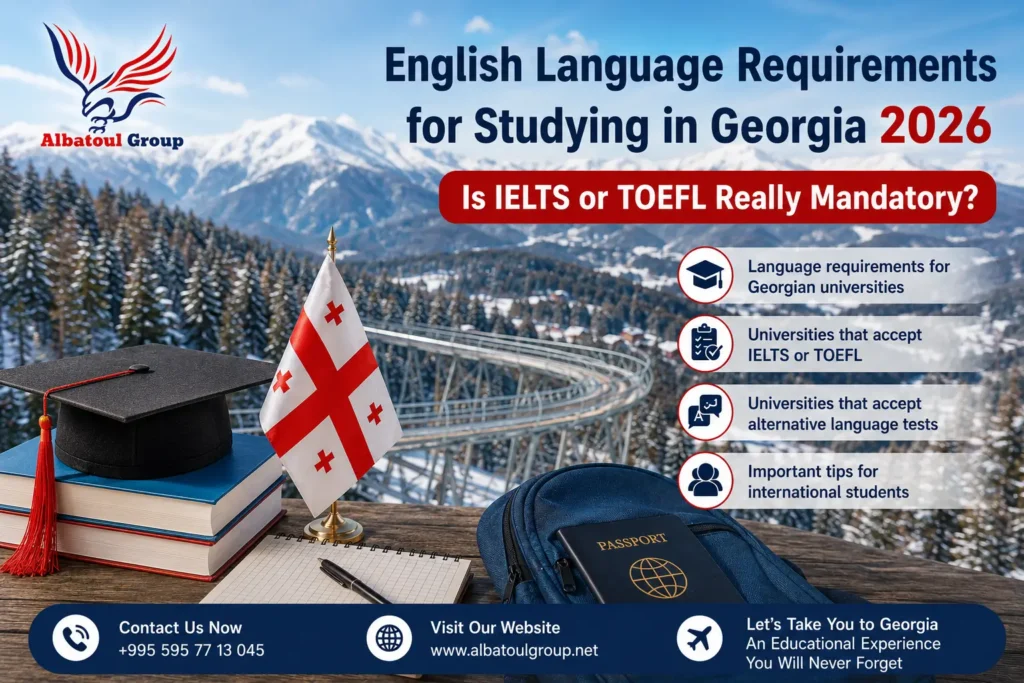
The First Truth: There’s No Uniform Requirement Across All Georgian Universities
Unlike countries like the UK or the US, which impose a roughly fixed minimum standard across nearly all universities, Georgia has no central legislation mandating a specific English certificate as a compulsory admission requirement. Each university — and sometimes each faculty within the same university — sets its own policy, which is exactly why you’ll find conflicting information online from one agency to another.
The most commonly requested standard across most universities is a B1 or B2 level under the Common European Framework of Reference for Languages (CEFR), but the way a university lets you prove you’ve reached that level varies significantly.
What Alternatives Are Accepted to Prove Your English Level?
Based on a review of actual policies at several Georgian universities, here are the most commonly accepted methods:
- A certified IELTS or TOEFL score — still the most widespread and accepted option, but not the only one.
- Proof of at least one year of prior education conducted in English (a high school or university certificate showing English as the medium of instruction).
- Cambridge English certificates (such as FCE, CAE, or CPE) at some universities.
- An online personal interview to assess basic English communication ability — the most common method specifically at medical universities.
- An internal placement test administered by the university itself if the applicant has none of the above.
Real Examples From Different Georgian Universities
Tbilisi State Medical University (TSMU)
According to data from international admissions offices, TSMU does not formally require an IELTS or TOEFL certificate. Instead, it conducts a simple online interview to assess the applicant’s English communication level, which is sufficient in most cases for non-native English-speaking Medicine applicants.
International Black Sea University (IBSU)
By contrast, IBSU requires a minimum IELTS score of 6.0 or a TOEFL score of 78, unless the applicant’s prior education was conducted entirely in English, in which case the requirement is waived.
Caucasus International University (CIU)
CIU accepts either an IELTS/TOEFL certificate or proof of prior English-medium education — a flexible system that gives applicants more than one path to prove proficiency.
Alte University and Akaki Tsereteli State University (ATSU)
Both universities require a minimum B2 level, and accept either a certified international certificate or proof of at least one year of prior English-medium education. If neither is available, the applicant takes an internal language test after the interview stage.
Important Warning: Beware the Phrase “Without IELTS” in Ads
Many agencies use the phrase “study in Georgia without IELTS” as a marketing hook, and that’s not inherently false — but it doesn’t mean you won’t need to prove your English level at all. The real meaning is usually that the university doesn’t specifically require an IELTS certificate, but it still needs to confirm you can follow instruction in English, whether through an interview, an internal test, or alternative proof. If someone tells you “you’ll be admitted with zero language assessment whatsoever,” that’s a claim you should verify directly with the admissions office before paying any fees.
Is Your English Level Weak? What Are Your Options?
If you feel your English isn’t strong enough yet, you have more than one option before applying:
- Foundation/Preparatory language programs: Some Georgian universities offer an intensive preparatory year in English before the main academic program begins, designed for students who need extra time to raise their level.
- Apply directly for the university’s internal language test: Instead of paying for a full IELTS course, you can try the university’s simpler, cheaper internal exam.
- Prepare for the personal interview: If the university relies solely on an interview (like TSMU), focus on basic communication and confidence in speaking rather than complex grammar.
Why You Should Confirm the Exact Requirement Before Applying
Because non-refundable application fees (like the typical $250 fee at most universities) are usually paid before you know the final result of your language assessment in some cases, it’s essential to confirm the right proof-of-language path for you before committing to any payment — not after.
The Al-Batool Group team can clarify exactly what’s required for your chosen university and program, and whether you’ll genuinely need an international certificate or whether an interview or internal test will suffice, before you start any procedure.
Frequently Asked Questions About English Language Requirements in Georgia
Do I need an IELTS certificate to study in Georgia? No, it’s not a uniform requirement across all universities. Some universities (like TSMU) rely on a simple personal interview, while others (like IBSU) genuinely require an IELTS or TOEFL certificate unless your prior education was fully conducted in English.
What’s the minimum English level generally required? Most universities require a B1 or B2 level under the Common European Framework of Reference (CEFR), whether proven through an international certificate, an internal test, or an interview.
If I don’t have any language certificate, does that mean I can’t enroll? Not at all. Most universities provide an alternative, such as an internal language test or a personal interview to assess your level, which is often sufficient without needing a full IELTS course.
Are Cambridge certificates (FCE/CAE) accepted instead of IELTS? At some universities, yes — but not all of them accept these, so it’s important to confirm your specific university’s policy before relying on one.
Is the “study without IELTS” claim I see in ads actually true? Partially. It usually means the university doesn’t specifically require an IELTS certificate, but it still needs to confirm your language level some other way (an interview or internal test) — not that you’ll be admitted with zero language assessment at all.
Want to know exactly what English language requirement applies to the university you’re deciding on? The Albatoul Group team can clarify the precise details and determine the best path for you before you commit to any fees.