Georgia Student Visa 2026: Why the Visa is Your Greatest Challenge
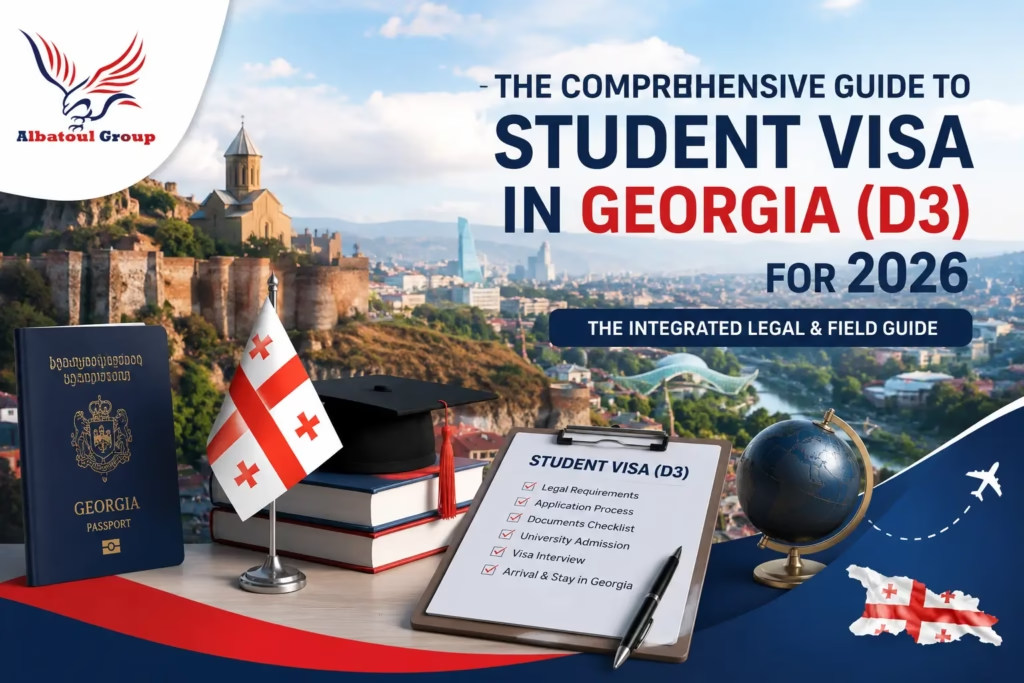
Georgia Student Visa 2026 securing university admission in Georgia might take a few days, but securing a Student Visa (D3) is a meticulous legal process that requires patience and extreme attention to detail. In 2026, with the increasing global demand for education in Georgia, the Georgian Ministries of Foreign Affairs and Internal Affairs updated the visa system to be more digital but also more rigorous in verifying a “student’s genuine intent.” At Albatoul Group, with years of experience in the heart of Tbilisi, we have crafted this massive guide exceeding 2000 words to be your comprehensive legal and field manual, accompanying you from the moment you receive your admission letter until you hold your residency card in your hand.
Georgia Student Visa 2026 : Understanding the Georgian Visa System for 2026
What is the Category (D3) Visa?
The (D3) visa is a long-term visa granted to individuals coming to Georgia for educational purposes, including students enrolled in universities, researchers, and interns. This visa is an “entry permit” that allows you to stay in the country for a specific period (usually 90 days) until you can begin official residency procedures.
New Legal Updates (July 2026)
1.Unified Digital Link: The Ministry of Education’s database (which issues admission orders) is now directly linked with the Ministry of Foreign Affairs’ system (which processes visas). This means the consul can now verify the authenticity of your admission with a single click.
2.Stricter Financial Oversight: Bank statements are no longer a routine paper; they are now subject to scrutiny regarding the “source of funds” and their adequacy to cover medical specialties in particular.
3.Remote Interview System: In some countries, video interviews have been adopted as an alternative to in-person interviews, maintaining the same level of rigor.
Chapter 2: The Golden Document List (No Room for Error)
For your file to be accepted the first time, your documents must be “perfect.” Here is the detailed breakdown of each document:
1. International Passport
•Requirement: Must be valid for at least 6 months after the requested visa expires (we always recommend having a full year).
•Note: Ensure there are at least two blank pages and that the passport has no physical damage.
2. Final Admission Order (Order of Enrollment)
•This letter is issued after approval from the Georgian Ministry of Education and Science. It must contain your full name as in the passport, the university’s name, the major, and the language of instruction.
•Warning: Ensure the study start date mentioned in the letter has not passed by more than a month when submitting the application.
3. Proof of Financial Means
This is the most sensitive part of the visa file. The consul wants to ensure you won’t have to work illegally to cover your expenses.
•Bank Statement: Must be for the last 3 to 6 months.
•Required Amount: For 2026, it is recommended to have no less than $5,000 for regular students and $8,000 for medical students (to cover the first installment and living expenses).
•In Case of a Sponsor: A legally notarized “Sponsorship Letter” must be submitted along with proof of kinship and the sponsor’s bank statement.
4. Proof of Accommodation in Georgia
•Option 1: A letter from the university confirming student housing is provided for you.
•Option 2: A notarized lease agreement from an apartment owner in Georgia, with a copy of their ID and proof of property ownership. (At Albatoul Group, we help our students secure this contract before they arrive).
5. International Health Insurance
•Must cover at least 30,000 Euros and be valid throughout the entire territory of Georgia for the initial visa period.
6. Personal Photos and Biometric Processing
•Recent photos with a white background (3.5 * 4.5 cm), complying with international biometric photo standards.
Chapter 3: The Application Journey Step-by-Step
Step 1: Registration in the Electronic Visa System
Access the geoconsul.gov.ge portal and create an account. You will upload all the aforementioned documents in high-quality PDF format. Any unclear document may lead to an immediate rejection.
Step 2: Paying Consular Fees
The fee is typically around $40 USD (or its equivalent in local currency). Payment is made online or at the bank specified by the consulate. Keep the payment receipt as it is part of your file.
Step 3: Booking the Interview Appointment
After the file is reviewed electronically, you will receive an email to schedule a personal or virtual interview. During peak seasons (August and September), appointments can be far off, so early application is the secret to success.
Chapter 4: Consular Interview Guide (The 20 Most Common Questions)
The interview is the moment the consul decides whether you are a “genuine student” or a “migrant seeking work.” Here are the most important questions and how to answer them:
1.Why did you choose Georgia specifically for your studies? (Answer should focus on education quality, international recognitions like WFME, and logical costs).
2.What do you know about your university? Where is it located? (You must know the university’s full name and its location in Tbilisi or Batumi).
3.What is your major and what will you study in the first year? (Review your study plan thoroughly).
4.Who will cover your study expenses? What is their profession? (Be honest and clear about the source of income).
5.Where will you live upon arrival? (Mention details of the accommodation you secured).
6.Do you intend to stay in Georgia after graduation? (The correct answer is: “I intend to return to my country to serve my community with what I have learned.” Consuls do not favor permanent migrants on study visas).
7.Do you know anyone in Georgia?
8.How will you overcome the language barrier?
9.Why didn’t you study this major in your home country?
10.What is your career plan 6 years from now?
(Note: At Albatoul Group, we conduct intensive training sessions for our students to simulate this interview).
Chapter 5: Secrets to Avoiding Visa Rejection (Expert Tips)
Since 2018, we have seen hundreds of cases. Here are the fatal mistakes to avoid:
•Information Contradiction: If you say in the interview that your father is a trader, while the bank statement shows he is an employee, this is sufficient reason for rejection.
•”Sudden” Bank Account: Depositing a large sum suddenly a day before extracting the bank statement raises suspicions about “freezing funds” for visa purposes only.
•Weak English Language: If your program is in English and you cannot understand simple consular questions, you will be rejected for linguistic ineligibility.
•Uncertified Documents: Ensuring the “Apostille” stamp or Ministry of Foreign Affairs legalization for your educational certificates is indispensable.
Chapter 6: After Obtaining the Visa – The Tbilisi Journey
Congratulations! You got the sticker on your passport. But the work isn’t over yet.
1. Preparation for Travel
Ensure you carry original documents with you in your hand luggage (admission letter, bank statement, insurance). Passport control at Tbilisi airport may ask to see them again.
2. Student Residency Procedures (TRC)
Once you arrive, you have a narrow time window (we recommend starting within the first two weeks):
•Medical Check-up: You must undergo blood tests and X-rays at a certified laboratory in Georgia to ensure you are free of infectious diseases.
•Public Service Hall (Justice House): This is the famous mushroom-like building in Tbilisi where you will submit your residency application.
•Fees: Fees vary by processing speed (10 days, 20 days, or 30 days).
3. Opening a Local Bank Account
You will need to open an account at the Bank of Georgia or TBC Bank to receive transfers and pay university fees. You will need your passport and a Georgian phone number.
Chapter 7: Costs and Fees (The 2026 Comprehensive Budget)
To avoid surprises, here is the approximate calculation:
•Visa Fee: $40.
•Translation and Legalization within Georgia: $100 – $150.
•Medical Check-up for Residency: $40 – $60.
•Residency Card Fee (Justice House): $100 – $250 (depending on speed).
•Annual Health Insurance (Local): $150 – $250.
Chapter 8: Why Albatoul Group is Your Best Partner?
We don’t just provide a registration service; we provide “peace of mind.”
•On-the-Ground Presence: Our office in the heart of Tbilisi means we are with you every step of the way, from the airport to housing.
•Institutional Relations: Our direct communication with universities speeds up the issuance of admission letters and corrects any errors.
•Legal Expertise: Our team is familiar with all the loopholes in Georgia’s foreign national law, reducing the rejection rate for our students to less than 1%.
Frequently Asked Questions about Georgia Visa 2026 (FAQ)
Q: Can I convert a tourist visa to a study visa from within Georgia?
A: In 2026, laws prevent this conversion for most nationalities. You must exit and apply from the embassy in your home country.
Q: What do I do if my visa application is rejected?
A: You have the right to appeal within 10 days, or wait for a certain period and reapply with a stronger file. We help analyze rejection reasons and provide legal solutions.
Q: Am I allowed to work with a student visa?
A: Yes, Georgian law allows students to work part-time (20 hours per week) provided it doesn’t affect their academic performance.
Q: Does the visa guarantee my entry?
A: The visa is a “permission to arrive at the airport,” and the final entry decision lies with the immigration officer. This is why we emphasize carrying all supporting documents when traveling.
Georgia Student Visa 2026 : Your Future Starts with a Correct Document
A journey of a thousand miles begins with a single step, and in the world of studying abroad, that step is the “visa file.” Do not underestimate any detail, and do not leave your future to superficial information. At Albatoul Group, we promise to do our utmost to turn this complex path into an easy and successful journey.
Contact us today, and let’s start preparing your Golden File for 2026.