Introduction: Why Georgia Dominates the Global Medical Education Scene
Studying medicine is a dream for thousands of high-achieving students worldwide. However, barriers such as complex admission requirements and exorbitant costs in Western countries often stand in the way. Georgia emerges as a brilliant solution, offering a unique equation: European-standard medical education, full international recognition, and affordable costs. At Albatoul Group, based on our field experience in Tbilisi since 2018, we have prepared this detailed guide to answer all your questions about studying Human Medicine and Dentistry in Georgia for 2026.
International Accreditations: Is a Medical Degree from Georgia Globally Recognized?
This is the most critical question for any international student. The short answer is a resounding yes. The medical education system in Georgia is designed to comply with global requirements, opening doors for graduates to work in top health institutions worldwide.
1. WFME Recognition (World Federation for Medical Education)
Georgia is one of the few countries whose national quality assurance bodies have received WFME recognition. This accreditation is the “Gold Seal” that allows graduates of Georgian universities to apply for the United States Medical Licensing Examination (USMLE) and obtain ECFMG certification to practice in the United States .
2. World Health Organization (WHO) and WDOMS
All leading medical schools in Georgia are listed in the World Directory of Medical Schools, a prerequisite for degree recognition in most countries, including the UK, Europe, and the Middle East .
3. Preparation for PLAB and USMLE Exams
The curricula in Georgia are heavily based on American and European systems, making it easier for students to prepare for the Professional and Linguistic Assessments Board (PLAB) for the UK and USMLE for the USA during their years of study.
Best Medical Schools in Georgia for 2026: A Detailed Comparison
Georgia hosts elite universities offering medical programs in English. Here is a comparison of the most prominent ones:
1. Tbilisi State Medical University (TSMU)
•Status: The oldest and most prestigious university in the Caucasus.
•Features: It possesses the largest network of university hospitals and specialized clinics.
•Language: Offers complete programs in English.
•Fees: Approximately $8,000 per year.
2. European University
•Status: One of the fastest-growing and most developed universities in the medical field.
•Features: Features a state-of-the-art medical virtual reality simulation center and focuses heavily on early clinical training.
•Fees: Approximately $5,000 – $6,000 per year.
3. University of Georgia (UG)
•Status: The largest private university with world-class laboratory facilities.
•Features: Provides a very modern learning environment and focuses on medical scientific research.
•Fees: Approximately $6,000 per year.
4. Caucasus International University (CIU)
•Status: Highly preferred by international students due to flexible admission procedures.
•Features: Offers strong programs in Dentistry and Pharmacy alongside Human Medicine.
•Fees: Approximately $5,000 per year.
The Human Medicine (MD) System in Georgia
•Duration: 6 years (360 ECTS credits).
•First Three Years (Pre-clinical): Focus on basic sciences such as Anatomy, Biochemistry, and Physiology.
•Last Three Years (Clinical): Intensive clinical training in hospitals and direct patient interaction under the supervision of experienced doctors.
Studying Dentistry in Georgia
•Duration: 5 years (300 ECTS credits).
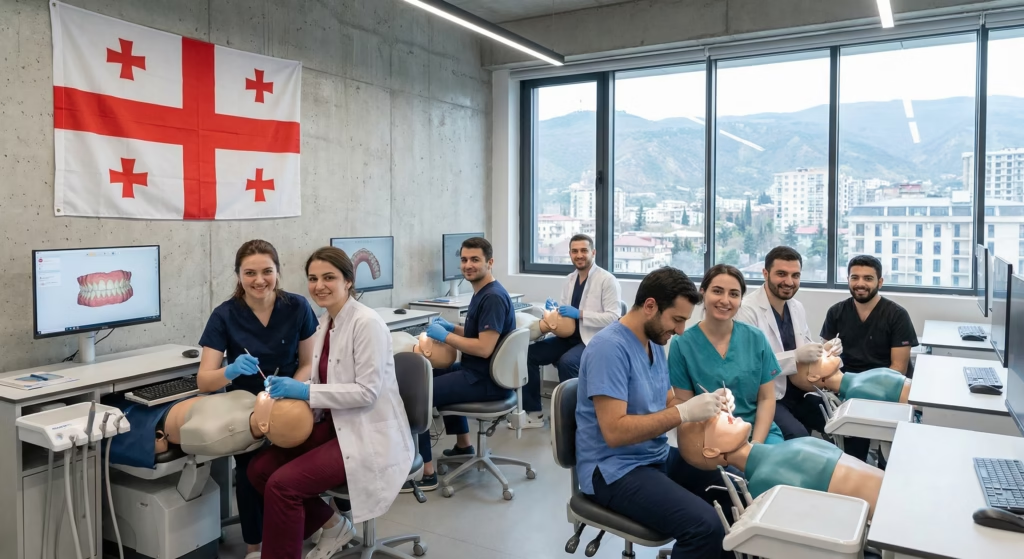
•Features: Georgian universities focus on the practical aspect starting from the second year, providing students with educational dental clinics equipped with the latest digital technologies.
•Fees: Ranges between $4,500 to $5,500 per year.
Cost of Medical Study in Georgia vs. Other Countries (2026)
| Country | Average Annual Fees (USD) | Cost of Living |
| Georgia | $5,000 – $8,000 | Very Economical |
| Turkey | $15,000 – $25,000 | Moderate |
| Poland | $12,000 – $16,000 | High |
| United Kingdom | $35,000 – $50,000 | Very High |
Clinical Training and Hospitals: Where Will Students Train?
Georgian universities contract with major public and private hospitals in Tbilisi. For example, TSMU students train at “Ingorokva High Medical Technology University Clinic” and “Todua Medical Center,” which are advanced medical centers featuring the latest diagnostic and surgical equipment in Eastern Europe.
Admission Requirements for 2026: Are They Difficult?
Unlike other countries, admission requirements in Georgia are very logical:
1.High School Diploma: Students must have studied science subjects (Biology, Chemistry, Physics).
2.English Language: No official IELTS certificate is required in most universities, but an online interview is conducted to ensure the student’s ability to communicate and understand the curriculum.
3.Age: There is no specific age cap, providing opportunities for those wishing to change their career path and study medicine.
Student Visa (D-3) Procedures for Medical Students
Medical student visas require special precision due to the long duration of study. At Albatoul Group, we handle:
•Complete embassy file preparation.
•Securing the final admission letter approved by the Ministry of Education.
•Ensuring health insurance and documented accommodation requirements are met.
Daily Life of a Medical Student in Georgia
Medical study is demanding, so Georgia provides a comfortable environment for relaxation:
•Safety: Students can move around at any time thanks to very high safety rates.
•Student Community: You will find thousands of students from India, Nigeria, the UK, Europe, and Arab countries, creating a culturally rich environment.
•Expenses: With a budget ranging from $400 to $600 per month, a student can live very comfortably, covering housing and food.
Why Register with Albatoul Group for Medical Studies?
•Academic Guidance: We help you choose the university that matches your ambition (whether you want to work in the US, Europe, or return to your home country).
•Interview Preparation: We train you for the admission interview to ensure your success.
•On-the-Ground Support: Our office in Tbilisi provides support in obtaining residency, opening a bank account, and providing accommodation near teaching hospitals.
Frequently Asked Questions (FAQ)
Q: Is the Georgian medical degree recognized in the USA and UK?
A: Yes, Georgian degrees from universities accredited by WFME and WHO are recognized globally, allowing you to take the USMLE and PLAB exams.
Q: Can I transfer to a Georgian university from another country?
A: Yes, most Georgian universities accept transfer students and will evaluate your previous credits for equivalence.
Q: What is the primary language of instruction for international students?
A: The vast majority of international students choose programs that are taught entirely in English.
Q: When should I start my application for the 2026 intake?
A: It is best to start as early as possible, typically in May for the Fall intake, to ensure you secure your spot and have enough time for visa processing.
Q: Do I need to learn the Georgian language to live there?
A: While the programs are in English, learning basic Georgian phrases can be helpful for daily life, although most young people and professionals in Tbilisi speak English.
Conclusion
Choosing to study medicine in Georgia for 2026 is a strategic decision that guarantees excellent education and an unforgettable life experience. With Albatoul Group, we ensure your journey is smooth and successful from day one. Don’t miss out—contact us now and start building your future.
References and Sources:
[1] World Federation for Medical Education (WFME) – Georgia Recognition Status
[2] World Directory of Medical Schools (WDOMS) – Search for Georgian Universities
[3] Ministry of Education and Science of Georgia – International Students Statistics
[4] 2026 Tuition Fee Reports – Official University Websites (TSMU, European University, UG).